
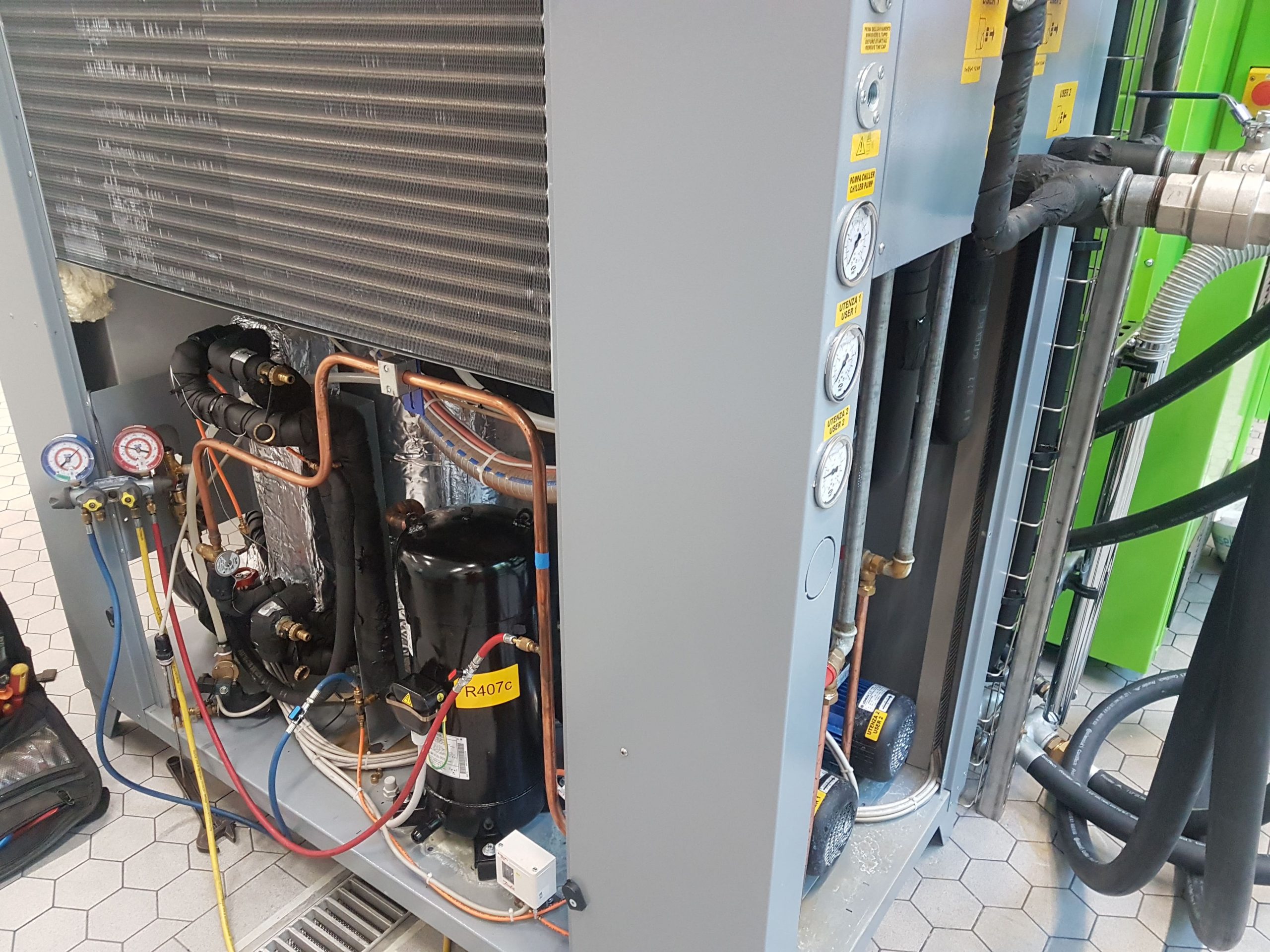
Maximus Chillers recently carried out process chiller maintenance to an Italian machine.
Process Chiller Maintenance for Water Level Sensor
The process chiller has a water treatment schedule, but the water level sensor needed maintenance. This is because the three probes of the sensor were not completing continuity. The probes complete the continuity from the wire going into the sensor, along the probe, then to another wire back to the controls of the chiller.
Low Water Probe
If the controls loose continuity to the low water probe, the alarm is triggered and a call out is arranged to resolve the issue.
Correct Level Probe
In normal operation, the correct level probe is activated and the chiller runs as normal.
High Water Level Probe
Should the high water level probe be activated, again the alarm is triggered and a call out arranged.
0161 237 3727
service@maximuschillers.com
Process Chiller Maintenance Call Out
As we were already on site to carry out the maintenance, there was no need to arrange a call out. We soaked the sensor for an hour in a special a decontamination chemical that has been designed to restore the probes. That done, the rest of the maintenance was carried out including the tightening of the wiring and motor connectors. It was possible to do this on this visit as the factory was not in production.
Run Testing
All readings around the chiller were taken when the factory went back into production. We found the fridge system to be working with optimum efficiency, meaning that the chiller will use the optimum amount of electricity. Efficiency is a great concern to a factory as they want to reduce their carbon footprint as much as possible.
Tick Sheet
Having got the chiller up and running, our engineer started with the maintenance Tick Sheet. He first had a look around the chiller to see if everything was tidy and in order. He then took the Tick Sheet out, attached it to his clipboard and filled out the model number and serial number details.
Stop Checks
There are a range of stop checks that are carried out when the chiller is not running. These checks include:
• Tightening the wiring in the panel.
• Tightening the motor connectors on the compressor.
• Tightening the wiring on the components around the chiller.
This is because the vibration of the chiller causes the wiring to loosen over time. Loose wires cause intermittent and problematic electrical problems, such as sensors reading wrong and spurious trip outs.
Refrigerant Health Check
The chiller was then started with full load available. This was so that the compressor would be running in full load conditions. Any faults with the chiller will show up when it is working at full capacity. Low pressure and high pressure gauges are fitted on this chiller which removes the need to fit manifold gauges to the refrigerant system. Test equipment was fitted to the relevant parts of the fridge system and an app was used to work out the superheat and subcooling values. These values were found to be within standard industry guidelines and were then recorded on the Tick Sheet.
Water System Health Check
The water system comprises of:
• Inlet and Outlet of the evaporator.
• Water system regulating valves.
• Pressure relief valves.
• Process water system pump.
• Chiller water system pump.
Test ports are available on the chilled water system for our engineer to fit the relevant gauges and test equipment. Having done this, our engineer recorded the readings on the Tick Sheet. All readings were found to be within standard industry guidelines.
Oil Level
The oil level on the sight glass was found to be correct and was recorded on the Tick Sheet. This shows that the oil was returning satisfactorily back to the compressor. A poor oil return condition will result in expensive compressor failure.
Oil Temperature
Oil temperature on the compressor was found to be satisfactory. High oil temperature again will cause expensive compressor failure. A low oil temperature can be due to refrigerant issues near to the compressor. This is as a result of incorrect refrigerant handling. Another reason for the customer to ensure full servicing is carried out by Maximus Chillers.
Condenser Condition
As this chiller works in an industrial environment, the condenser is prone to becoming blocked. It is a part of the schedule of the onsite maintenance engineers to carry out condenser cleaning at regular intervals. As well as this, according to our maintenance schedule, a condenser chemical clean is carried out twice a year. At Maximus Chillers, we use our own special condenser cleaning compound that we produce ourselves at Head Office. This is because other chemical cleaning compounds can rot the condenser pipe work. This, over a period of time, causes reoccurring refrigerant leaks.
Amps and Volts
The amps and volts were checked across the various electrical components. These components include:
• Compressor.
• Chiller pump.
• Condenser fan.
• Liquid line solenoid coil.
Having previously tightened the wiring in the panel, irregular volt readings had been eliminated. These checks are all parts of the service with Maximus Chillers.
Related Articles:
R134a Chilling Plant Maintenance
Air Cooled Chiller Planned Maintenance
Chilled Water System Maintenance
Centrifugal Chiller Maintenance
Industrial Chiller Maintenance
Air Cooled Chiller Condenser Maintenance
Planned Preventative Chiller Maintenance
Air Cooled Chiller Maintenance
Preventative Chiller Maintenance
Read about the IOR celebration of service engineers