
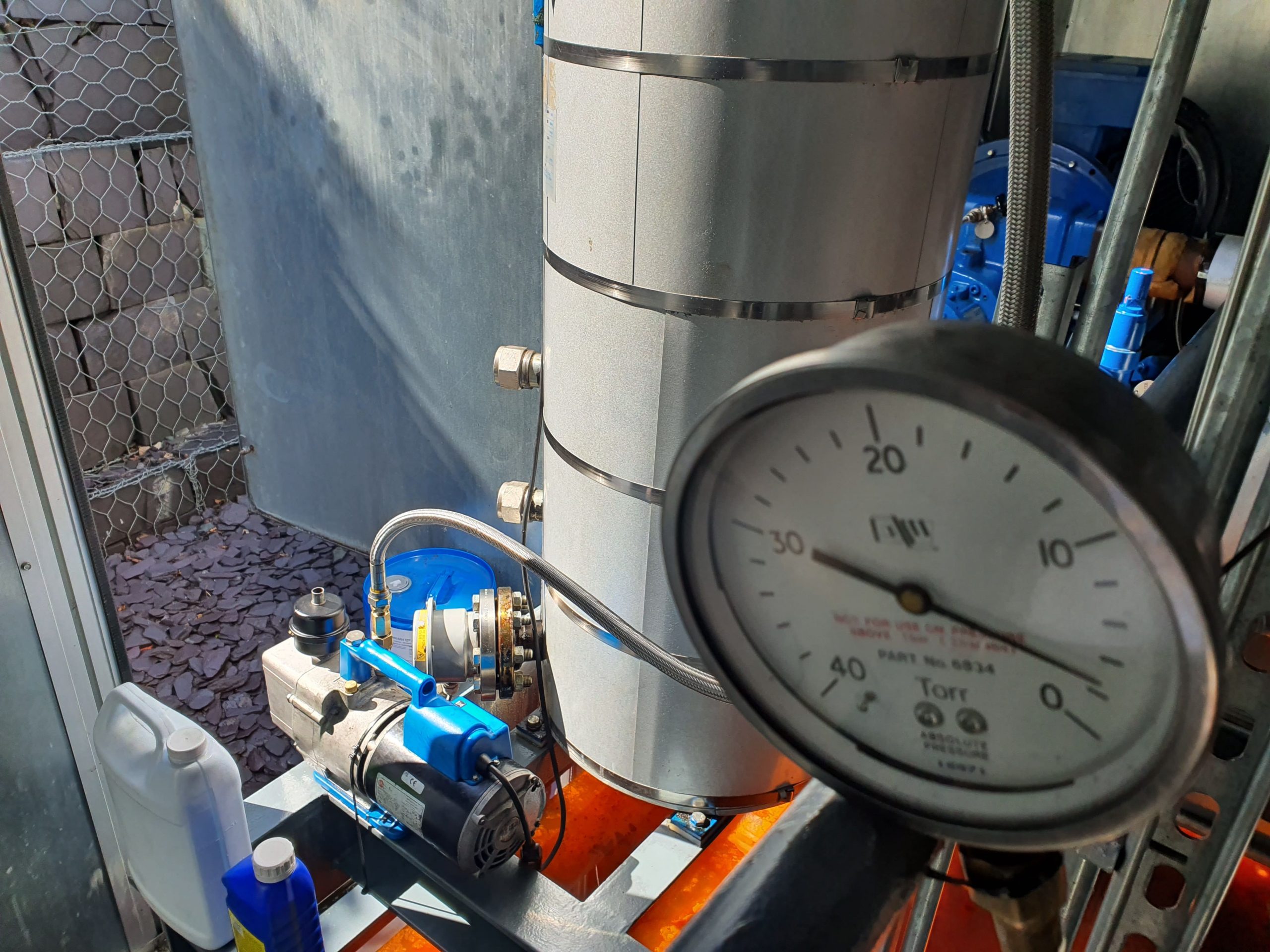
During a recent process chiller vacuum service, our engineer achieved a deep vacuum of 2 Torr. This is the same pressure as if the Torr gauge had been fitted directly to the vacuum pump.
Torr Gauge
The Torr gauge was fitted to a refrigerant hose. The refrigerant system uses a different kind of fitting used for breaking in. Therefore, an adaptor fitting was used to go between the two kinds of fitting. A specialist sealant was used between the adaptor fitting and the refrigerant system and another sealant was used between the adaptor fitting and the refrigerant hose. This completed, the Torr gauge was located in a convenient location for inspection on achieving a deep vacuum.
0161 237 3727
service@maximuschillers.com
Process Chiller Service Vacuum Pump
Each of our engineers is issued with a high capacity 10 cfm vacuum pump. Only the best equipment will do at Maximus Chillers. The oil was changed as per standard industry procedures and the correct level of oil was checked. The vacuum pump was ran up to operating temperature for half an hour with the inlet valve closed. This was to ensure the correct operating temperature of the oil was achieved before load was given to the pump. A steel braided refrigerant hose with bolted ends fits with the service ports on the refrigerant system. Therefore, adaptor fittings were again used to get between this hose and the vac pump.
Dehydration Process
The purpose for evacuation is the removal of moisture from the refrigerant system. Air contains usually around 50% relative humidity of moisture carried within it. Air had ingressed into the system during the works that had been carried out. The boiling point of moisture is 100°C at 760 Torr (1 bar absolute: Earth’s air pressure at sea level) This boiling point drops, corresponding to pressure until at 15°C the boiling point of water is 10 Torr. The boiling point of water at 0°C is 5 Torr. Therefore, with our vacuum pump achieving 2 Torr, a dry system is capable of being achieved regardless of the UK ambient temperature. Also, various heaters were used to speed up the process. Eventually the pressure in the refrigerant system was recorded at 2 Torr.
Ammonia Refrigerant Delivery
As this refrigerant is highly toxic and corrosive, it has to be transported to site with a hazardous licenced haulage company. The vehicle has an orange plate on it to let other road users and members of the public know that hazardous substances are being carried. The driver of the vehicle goes through extensive training to make sure he knows how to handle emergency situations. These situations include a potential crash where the cargo has fallen onto the road. He carries all the necessary safety signs and clean up equipment to make the area safe until the fire service arrives.
We had scheduled the delivery to coincide with the vacuum of 2 Torr.
The driver arrived on site and security gave him directions to where the chiller was located. He asked our engineer where he would like the refrigerant to be stored. Our engineer directed him next to the chiller and the driver then unloaded the ammonia refrigerant and put it in to place.
Our engineer then tied off the cylinders to keep them in an open right position.
Ammonia Refrigerant Charging
Our engineer then fitted hoses to the cylinders and to the part of the machine where the refrigerant would be in its liquid state. The refrigerant was then charged into the system according to standard industry guidelines.
Pre Start Checks during Process chiller Vacuum Service
Having completed the charging of the refrigerant, our engineer carried out an extensive number of tests and procedures. This was to make sure that the system was safe to be run tested. These tests included a leak test and electrical testing of the compressor starter contactors.
Start Up Procedure during Process chiller Vacuum Service
Full load was available to the chiller so that compressor would load up to 100%. The chiller went through a pre start timer and then the compressor Star, then Delta contactors came in. The amps were monitored as the compressor loaded up. The loading is achieved with a slide valve and potentiometer. The potentiometer detects the position of the slide valve between 0% and 100%. The slide valve steadily opened to its fully open position. The amps at 100% were then recorded.
Run Testing during Process chiller Vacuum Service
The chilled water temperatures were monitored as the chilled water came down to set point. As it was nearing set point the compressor slide valve started to close to match the load coming from the water system.
Oil Return during Process chiller Vacuum Service
The oil level on the oil separator was monitored to ensure the correct oil return was being achieved. The oil is used to lubricate the screw in the compressor, to provide a seal between the rotors and to lubricate the bearings. An oil pump is fitted to get the oil pressure higher than discharge pressure to enable the slide valve to move. All of the oil return pressures and temperatures across the filter and on the inlet to the compressor were then recorded on our Tick Sheet.
Related Articles:
Chilling Plant Service
Chilled Water System EEV Service
Water System Service of Evaporator
Chiller Fault Finding & Diagnosis
Air Cooled Chiller Condenser Testing
Read more about the unit of pressure Torr on Wikipedia