
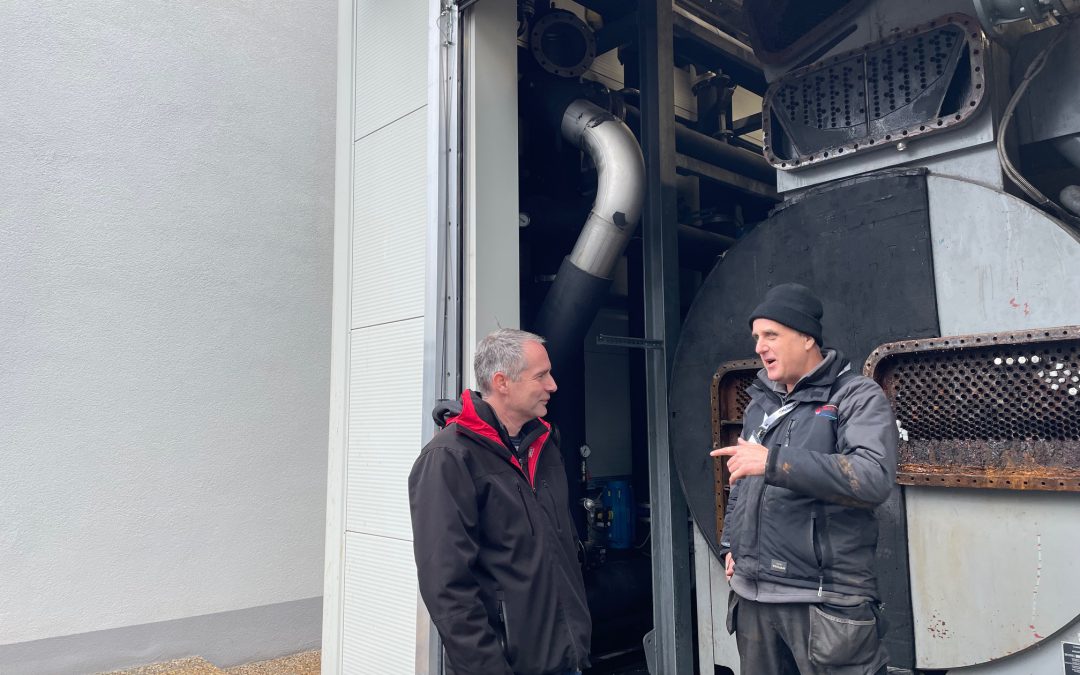
Maximus Chillers are currently carrying out a major absorption industrial process chiller repair after the heat exchangers were damaged in a chemical factory.
Heat Exchangers for Industrial Process Chiller Repair
There are 4 shell and tube heat exchangers on this absorption machine:
Generator
This is where hot water from the process is pumped through the tubes which separates the lithium bromide from the distilled water on the outside of the tubes in the fridge system.
Condenser
Water from the cooling towers is pumped through the tubes which condenses the refrigerant water vapour on the outside of the tubes in the fridge system.
Evaporator
The refrigerant water in the fridge system is at a deep vacuum. Therefore, the saturation point of this refrigerant water is low enough to boil off on the outside of the tubes in the fridge system. This chills the water down to 7°C which is pumped through the tubes to the process.
Absorber
The refrigerant water vapour which has boiled off in the evaporator carries the latent heat of vaporisation from the process chilled water, also the heat from the hot water from the generator. This refrigerant water vapour absorbs back into the lithium bromide and the cycle starts again.
0161 237 3727
service@maximuschillers.com
Pumps during Industrial Process Chiller Repair
There are 2 pumps for the fridge system.
Solution Pump
There is a solution pump which sucks from the bottom of the absorber and discharges the solution into the generator, it then drains back down into the absorber.
Refrigerant Pump
A refrigerant pump sucks refrigerant water from the bottom of the evaporator and discharges it back to the top of the evaporator to aid with boiling it off. The refrigerant water also drains down from the condenser and into the evaporator.
Set Point during Industrial Process Chiller Repair
The setpoint is regulated by the amount of hot water that is allowed to go through the tubes of the generator. The more hot water, the lower the temperature of the chilled water.
Cooling Towers
The cooling towers are located above the absorption chiller plant room. The cooling water is pumped through the absorber and then through the condenser before it returns back up to the cooling towers.
Burst Tubes during Industrial Process Chiller Repair
20% of the absorber and 50% of the condenser tubes have burst due to other works in the factory. The task is to repair the tubes and put the chiller back into operation. This is a major project as the cooling water from the cooling towers has flooded the system!
Drain Down
There are 2 service valves on the bottom of the refrigerant water side and the solution side. The lithium bromide, refrigerant water and cooling tower water was drained out of the system and into containers before being sent away for recycling.
Tube Repair during Industrial Process Chiller Repair
The burst tubes can be repaired according to standard industry guidelines. This method requires an eddy current testing machine to identify the exact location of the burst in the tubes. The tube repair kits are an alloy with an additive, a non reactive and 2 compounds.
Tube Replacement
The other option is to replace the heat exchangers completely with new ones. These need to be manufactured bespoke with the correct grade of pipework which is suitable for the system.
0161 237 3727
service@maximuschillers.com
Quotes during Industrial Process Chiller Repair
Quotes have been submitted to the customer and they are currently having meetings to decide the way forward. This depends on cost of the tube repair kits versus the cost of the replacement heat exchangers. Also, the lead time of the heat exchangers will be taken into consideration as the summer is coming and a lot of money will be saved by using the absorption chiller…
Cost Saving of Heat Recovery
As there is heat made during the process as a bi-product, this heat can be recovered and used to make chilled water in the absorption chiller. This is a considerable cost saving compared with vapour compression chillers…
Air Cooled Chiller
The alternative is to make chilled water using an air cooled chiller located nearby. A lot of amps are pulled to drive the scroll compressors and the condenser fans of this machine and this adds up to a lot of money.
Centrifugal Chiller
There is also a small centrifugal chiller available in the plant room opposite to the absorber plant room. This chiller also uses electricity to drive the compressor and a cooling tower to cool the condenser on top of the building.
Cooling Towers during Industrial Process Chiller Repair
There are 3 tanks that are used for the process: 35°C which is used for the start of the process, 24°C which is used for the middle of the process and 15°C which is used for the final stages of the process. Cooling towers satisfy some of this demand with the chillers providing the rest of the demand. During the winter, most of the demand is supplied with the cooling towers. In the summer, the absorption chiller feeds the 15°C tank at low cost.
Job Progression
As the job progresses, an update will be added in a further post. A really interesting job as it is complex with many challenges and procedures which need to be carried out to get the chiller into operation. These procedures include:
Pressure Test
As this system works on a vacuum, the pressure test procedure is different to a vapour compression chiller. The tube repair kits need to be proved to be leak free before moving on to the next stage…
Dehydration and Decontamination Process
The water and contamination need to be removed from the system before the chiller can be charged with lithium bromide and refrigerant water.
People also like this page:
Industrial Process Chillers
Related Articles:
Process Chiller Vacuum Service
Hit the Tags below to navigate your way to our extensive library of further reading on this subject.
Read more about absrption chillers on The engineering Mindet.